Strategy
Why ESG Disclosure Is So Difficult In The Canadian Mining Industry
In recent years ESG reporting has become a core expectation of any large—and certainly any public— company. Investors want sustainability information that is financially material so they can compare it across companies. Regulators are turning once voluntary disclosure frameworks into rules. Lenders, insurers, and customers are increasingly treating environmental and social performance as a proxy for management quality. Communities want to know what specific impacts a company is having on them.
There are very few industries that feel this mounting pressure more than the mining sector. The energy transition from fossil fuels to renewables runs through the mining sector: batteries, electric vehicles, and wind turbines all depend on minerals that mining companies have to dig out of the ground. The International Energy Agency (IEA) projects that lithium demand will grow roughly fivefold by 2040, while copper demand will grow by about 30% (IEA, 2025). At the same time, mining carries some of the most serious environmental and social risks of any industry. This paper will not be taking a position for or against mining, rather, it asks a practical question instead: what makes ESG reporting especially difficult for mining companies?
Why Mining Is Different
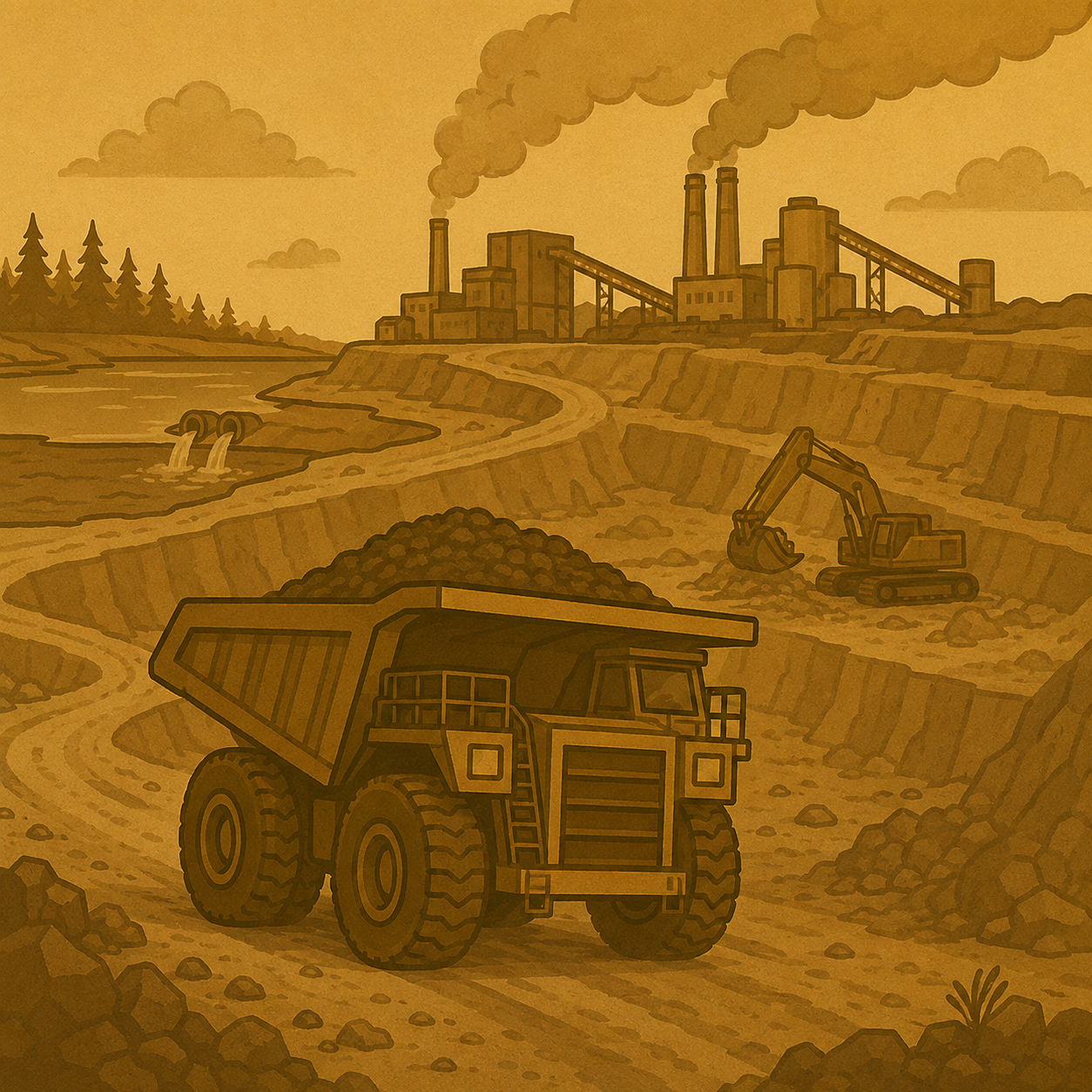
Most corporate ESG reporting deals with impacts that you can’t easily point to, for instance, a bank’s largest climate exposure sits in its loan book; a software company’s footprint is mostly electricity and travel. Mining is the opposite, most of its impacts are very locatable. In mining, impacts are mostly concentrated at specific sites: open pits that transform landscapes, workforces exposed to genuine physical hazards etc. A mine also affects a specific community, communities which are often on or near Indigenous territory, where consultation and consent are legal and moral obligations.
This local character is now written into the reporting frameworks themselves. The Global Reporting Initiative’s new sector standard for mining came into effect on January 1st, 2026, and goes by the name GRI 14. GRI14 identifies 25 topics likely to be material for mining companies, this includes things like greenhouse gas emissions and biodiversity to tailings, land and resource rights, and the rights of Indigenous Peoples. One of the most transformative requirements of the framework is that it explicitly requires several disclosures at the level of the individual mine site because impacts vary so much by location (GRI, 2024). Tailings management is one of the reasons the bar has risen. After the 2019 dam collapse at Brumadinho, Brazil killed 270 people, the industry, investors, and other parties like the United Nations came together to developed the Global Industry Standard on Tailings Management (ICMM, 2020).
A sustainability report in the mining industry isn’t just written up by someone behind a desk like what may be possible at a software company. Real, physically and technically difficult things have to happen. Crews sampling discharge water for instance, or technicians metering diesel and electricity to build an emissions inventory, geotechnical engineers monitoring whether a tailings dam is moving. Companies must also account for obligations that outlast the mine itself, since reclamation and post-closure water treatment can run for decades after production ends.
The Reporting Landscape
A mining company preparing its annual disclosures now faces several overlapping reporting regimes: the International Sustainability Standards Board’s IFRS S1 and IFRS S2 focus on information investors need about sustainability-related risks and opportunities that could reasonably be expected to affect the company’s cash flows, its access to finance or cost of capital. In 2024 Canada issued CSDS 1 and CSDS 2 as voluntary standards which are closely aligned with IFRS S1 and S2 but with a few adjustments including a three-year deferral for Scope 3 emissions disclosure (CSSB, 2024; Blake, Cassels & Graydon LLP, 2024). It should be noted however that these reporting frameworks are not yet required by law.
Global Reporting Initiative (GRI) answers a different question. Instead of asking what affects the company’s enterprise value, it asks what the company’s impacts are on people and the environment. GRI 14 does this primarily by pushing reporting down to the mine site. There are equally European rules that apply to miners with EU operations based here in Canada. Another layer is the industry systems in Canada, most notably the Mining Association of Canada’s Towards Sustainable Mining program, which requires things like site-level performance assessments, external verification, and annual public reporting as a condition of membership (MAC, n.d.).
For a mining company operating in multiple jurisdictions and selling into global markets, the problem is fundamentally coherence across all of its various types of disclosure. The standards that investors prefer ask for entity-level, financially material information; regulators and community stakeholders want detail specific to each particular site and care less about the financial implications; industry programs like TSM want to verify the performance of the systems that management has in place. The same tonne of water or carbon may need to be cut three different ways, and inconsistencies between the versions invite accusations of selective disclosure.
The Main Reporting Challenges
The first and largest challenge is data. Mining companies typically grow by acquiring other mining companies, but this model leaves them with a patchwork of site-level systems that weren’t built for external sustainability disclosure, rather many of these locations were designed simply to comply with regional regulations and maximize operational efficiency accordingly. Additionally, pulling consistent water, energy, and waste data from a mine in northern Ontario, a mine in Chile, and a joint venture in West Africa, while using the same definitions and timelines, is a genuine challenge.
The second challenge is comparability. A million cubic meters of water withdrawn to support mining operations means something entirely different in the Atacama Desert than in water-rich Quebec. Aggregated totals that a mining company discloses can be technically correct and yet still be misleading, and this is precisely why GRI 14 focuses on local context and site-level reporting (GRI, 2024). Calculating impact on biodiversity is even more difficult because there is no single accepted metric for ecosystem disturbance, meaning companies have to combine a variety of things like hectares disturbed, proximity to protected areas and ecological rehabilitation rates, but unfortunately none of those things can roll up neatly into a comparable figure.
Reporting emissions also has its difficulties: Scope 1 and 2 emissions from diesel fleets, blasting, processing, and purchased electricity are measurable with reasonably strong confidence. Measuring Scope 3 emissions is where it gets tricky because most of the carbon associated with a mining company’s product is emitted after the ore leaves the gate, in smelting, refining, and downstream use by customers that the miner doesn’t control. In fact this is the reason that the CSSB added the three years of relief before Scope 3 disclosure is expected to the CSDS (CSSB, 2024).
Another challenge that social reporting presents is the potential strain it can place on the relationship mining companies have with local Indigenous communities. Indigenous consultation and consent are ongoing and historically sensitive relationships, and a disclosure regime that reduces them to a count of meetings held carries with it the possibility of breeding tension in the relationship. Good reporting here requires explaining process and outcomes honestly, including where disputes exist, and this good-faith approach often sits uneasily with the instinct of legal counsel to say as little as possible.
Finally, the stakes attached to ESG claims that companies make are rising. Bill C-59 amended the Competition Act in a way that now requires companies to substantiate any public environmental claims or face significant greenwashing penalties (KPMG, 2025). This amendment will of course reach any sustainability disclosure a company makes public, meaning companies can’t just claim that they behave with environmental consciousness—they have to back it up. Assurance is following suit: investors are increasingly expecting sustainability data to withstand audit-style scrutiny, which is naturally pushing companies to control it as tightly as financial data.
The Energy Transition Paradox
Mining companies have to manage two stories at once. The first is that the world needs them in order to decarbonize, and this claim is entirely true: the IEA projects supply shortfalls by 2035 of roughly 30% for copper and 40% for lithium relative to expected demand under current policies (both materials are essentially for building things like power grids and EVs)(IEA, 2025). The second story is that extraction itself creates environmental and social harm, which is also true. The validity of both narratives is what makes ESG reporting in mining simultaneously very important and very difficult. High-quality ESG reporting is necessary to ensure that mining companies can continue playing their integral part in the future economy without facing undue hardship while at the same time not obfuscating their direct environmental impact.
The paradox actually occurs when a company markets itself as critical to the climate solution which thereby invites closer scrutiny of how its minerals are produced, and regulators armed with greenwashing provisions are increasingly willing to test the claims.
Why This Matters for ESG Advisors
Everything above explains why mining companies lean heavily on external advisors, someone has to run the materiality assessment that decides which of GRI 14’s 25 topics are actually relevant for a given portfolio of assets. Someone has to map the gaps between what a company currently discloses and what IFRS S2, CSDS 2, GRI 14, and TSM each require. Someone has to design the data architecture that can feed these various frameworks. Moreover, climate scenario analysis, which is now expected under CSDS 2, requires modelling skills most sustainability teams lack in-house (Blake, Cassels & Graydon LLP, 2024). Indigenous and community impact reporting requires a great deal of judgment about what can be said publicly without unduly burdening the business or breaching confidentiality. And companies need internal controls over sustainability data built before auditors arrive, which will be happening more and more as assurance expectations continue to grow.
Conclusion
A mining company isn’t reporting on abstract corporate values as some may think, it’s reporting on land it has disturbed, water it has drawn, workers it has to keep safe, and communities whose trust it has to earn/keep. The expansion of standards, the push toward site-level disclosure, and the arrival of greenwashing liability all place greater pressure on the miners to collect data, accurately measure it, and disclose it in good faith.
That points to a useful final insight: in this industry, the most credible reporters will be the companies that can explain their risks candidly, measure them carefully, and demonstrate, year over year, that those risks are being managed.
References
Blake, Cassels & Graydon LLP. (2024, December). Canadian Sustainability Standards Board publishes inaugural sustainability disclosure standards. https://www.blakes.com/insights/canadian-sustainability-standards-board-publishes-inaugural-sustainability-disclosure-standards/
Canadian Sustainability Standards Board. (2024, December 18). Canadian Sustainability Disclosure Standards (CSDS 1 and CSDS 2): Now available. FRAS Canada. https://www.frascanada.ca/en/cssb/news-listings/csds1_csds2_launch
Global Reporting Initiative. (2024). GRI 14: Mining Sector 2024. https://www.globalreporting.org/standards/standards-development/sector-standard-for-mining/
International Council on Mining and Metals. (2020). Global Industry Standard on Tailings Management. https://www.icmm.com/en-gb/our-principles/tailings/global-industry-standard-on-tailings-management
International Energy Agency. (2025). Global critical minerals outlook 2025. https://www.iea.org/reports/global-critical-minerals-outlook-2025
KPMG in Canada. (2025). CSSB sustainability reporting: Canadian Sustainability Disclosure Standards. https://kpmg.com/ca/en/services/environmental-social-and-governance/reporting/cssb-sustainability-reporting.html
Mining Association of Canada. (n.d.). Towards Sustainable Mining. https://mining.ca/towards-sustainable-mining/